So-called "radical" political protest and activism, from the great peasant revolts to the 'velvet' revolution, has always been, in the final analysis, about the big issues of justice, social and economic equality, and political representation. Sometimes activist movements have erupted into distinctly anti-capitalist efforts, more often such efforts are more modest and localized in nature. In the past thirty years or so in Western 'democratic' nations, activists' movements have generally been focused on protecting the gains that were made during the long post-war boom. The issues in this cause have been connected to holding the line on wages, workplace safety, tuition rises, public (and private) pensions, environmental protection, and the expansion of democracy. However, in the past decade or so we have seen a gradual change in discourse which has begun to subtly shift back toward the bigger issues of overall inequality and capitalism in general. Though this change is too general to be reduced to any one moment, I often think of the great WTO riots in Seattle. The reason for the change in discourse is fairly simple - the the post-war gains in economic and political equality are being lost and these losses coupled with a looming environmental crisis are causing a slow ideological change. Though the concentration in media control has made this ideological shift weaker and more gradual than it might otherwise be, the change is becoming palpable. The three primary areas that are changing people's minds are an awareness of the startling growth in income inequality in Western capitalist nations, the distinct attack being waged upon democracy by Western elites, and the environmental crisis. As usual, capitalists and economic and political elites have blithely ignored the general impact of their thirst for money and power and this is resulting in a growing number of people who are searching for the underlying causes of our big social and economic problems and the basic issues of capitalism will increasingly become a target for political activism. The more you take away from people the less they have to lose and the more they will look toward the economic system that is at the root of their perceived suffering.
Obviously the reaction of the economic and political elites to such activism will be predictable. They desperately attempt to portray economic inequalities as the outcomes of a "natural" and unchangeable process. Marx called it 'reification,' which is the portrayal of relations between people as only relations between things. They want you to believe that the control of our wealth by a handful of people is the result of some natural, unavoidable process rather than a result of a conscious effort by rich and powerful people.
Outside of the elite, a surprising number of people emulate the ideology of corporatism. The reasons for their support of such an ideology are multi-fold, but the primary reasons are pretty simple - ignorance and fear. Their ignorance is an almost total lack of historical and political knowledge, and their fear is the standard fear of, to borrow a phrase from Edmund Burke, the 'swinish multitude.' Many people see political activists on television and they imagine that any such activism will necessarily result in the rise of another Robespierre and the guillotine. The most unfortunate factor in this public ignorance and fear is that it often becomes the primary push toward greater and more dangerous radicalism. Events such as the French revolution are generally easily avoided through simple reforms. But elites, in their greed for money and power, get comfortable in their power and their egoism gradually convinces them that their positions and wealth are somehow 'god-given' and a natural expression of their merit. They are loath to succumb to reforms which may cede any of their wealth or power and in an effort to protect that power they gradually push the nation toward revolution. The scenario plays itself out over and over again until it begins to look like a comedy of errors, as it has over the past week in Quebec.
The political and economic elite in Quebec (and by association the rest of the nation) see the growing threat of radicalism expressed in a what began as a relatively simple student protest. Because the political elite are desperate to shift economic wealth away from the people and toward the rich and the corporate class, they gradually take the tax burden away from corporations and the rich and they slowly throw it onto the middle and working-classes. Anything that begins to threaten that shift strikes fear into the capitalist class, as it did in the Swing Riots of the 1830s or the anti-corn law riots in the 1840s. (In the early 1840s the Anti Corn-Law League whipped up the revolutionary fervor of working-class in an effort to overturn the Corn-Laws but it quickly betrayed the workers when it realized that the working-class didn't care that much about the corn-laws but they actually wanted real reforms in the system of industrial manufacturing.) In Quebec the ruling class was comfortable in ignoring the protests as long and it felt no threat to their overall plan to maintain their power. However, in the face of a perceived threat, it was the political elite that quickly expanded the issue beyond a protest over tuition fees and made it an issue of controlling dissent in general with a law that de facto attempts to stop protest altogether.
The efforts in Quebec may simply die away (as many such protests do). But make no mistake, these protests are part of a larger historical moment in which people are questioning the radically expanding wealth of a small group of people and a growing power of a corporate elite. Each time I see someone deride protestors as "selfish" or "stupid" I shake my head. As France inched toward revolution in the 1770 and 1780s the elites dismissed anyone who protested inequality as simple 'troublemakers" and "malcontents." And instead of reforming their shockingly unjust system of wealth, they further oppressed and attacked any and all opposition until it was too late and they found themselves at the wrong end of a guillotine. Deride radicals and activists if you will, but you do so at your own risk. Today they are only trying to protect their jobs, their right to an education, their pensions, and their basic democratic rights. Leave their demands unheeded and tomorrow you will find them in your gated communities, in your legislative buildings, in your corporate headquarters. And instead of carrying signs they will be carrying guns and bombs. And if you think it can't happen -- open a history book! It has happened time after time and it will happen again. As long as Western elites continue with their system of radical inequality it will not be a question of "will there be another revolution," rather it is only a question of "when will the next revolution be on our doorsteps?"
Thursday, May 24, 2012


Tuesday, May 22, 2012
Frances Trollope and Capitalism. . . .
I have been reading a remarkable book entitled Michael Armstrong: Factory Boy, written in the late 1830s by Frances Trollope (mother of the more famous Victorian novelist Anthony Trollope). This was, as far as I have been able to tell, the very frist serialized novel by a woman and it is a solid, expertly written work that deserves a much wider audience than it has heretofore enjoyed. In fact, I would say that it should be required reading in every high-school and university. The reason for this praise is that Michael Armstrong is finest novel I have read concerning the conditions of the working-class in England during the 19th century, beating out anything by Dickens and certainly more descriptive and enlightening than Engels' rather drab The Condition of the Working-Class in England written around the same time. Trollope travelled extensively through Lancashire (sometimes incognito) to research her novel.
Though it is difficult to read (due to its emotive descriptions), Michael Armstrong makes short shrift of the notion that capitalism is somehow about freedom, that trade unions are unnecessary, or that capitalism would treat people humanely in the absence of workers' solidarity and government legislation. The novel describes in painful detail the condition of those working in the cotton mills in the 1830s in Lancashire, particularly the children. Children worked in the factories from the tender age of five, often for 16 or seventeen hours a day. If they survived their tasks of climbing under the fast-moving and dangerous machinery ( a task given to them due to their small size) to clear cotton from the equipment, they were then subjected to brutal and monstrous beatings from their overlords, often suffering concussions and broken limbs during these beatings. They often lost limbs from the fast-moving machinery (or even died in accidents) and there was nothing given to the parents to compensate for these events. In some cases the children were indentured into apprenticeships. Though these were often legitimate, in some cases these apprenticeships were a front for a form of modern slavery in which the children were taken to remote factories and gradually worked to death. The manufacturers who owned these factories worked hard to hide the conditions under which their workers laboured, particularly the children, and they actively attempted to stop any legislation that would restrict their ability to exploit their victims.
As startling as the terrible working conditions were, Trollope's novel illustrates another, perhaps more shocking aspect of this awful exploitation - the ideology of class and the practice of blatant deception. In the early years of manufacturing the factory workers lived on the lowest rung of the social scale and Trollope shows the terrible ways in which other working-class people such as servants and farmers looked down on the factory workers as little more than animals. Meanwhile the manufactures propagated the idea that these workers were overpaid and lazy, and that the only reason that they were poor was that they were spendthrifts. Since few people associated with the factory workers, this notion was widely believed even by other working-class people.
It is striking the degree to which this ideological view of working people is still widely believed, as demonstrated any time a worker anywhere goes on strike and is instantly treated with derision by countless people who call them all selfish, shiftless, and lazy.\
Reading Trollope's Michael Armstrong; Factory Boy has been profoundly depressing to me. I know that the conditions therein described still prevail in many countries today and I have seen some of them myself in maquiladoras. It depresses me too because I know that though not all capitalists are evil, these conditions would quickly return everywhere if capitalism was given a free hand, and it is deeply naive to think otherwise. We are only ever one generation away from complete barbarism.
The other reason I find it depressing to read Michael Armstrong is because it reminds me of the degree to which little has really changed in the ideology of many people. Today on the radio I heard the student protestors in Quebec referred to as "spoiled, lazy malcontents." This is the exact sort of epithet which was given to the factory workers in Trollope's book and everyone else who has ever struggled for equality and justice. I would really like to take that radio announcer by the collar and remind him that everything our society has of value, from freedom from slavery to votes for women is a result of people who were once referred to as a group of lazy malcontents. In the 19th century the rich and powerful had the majority of people convinced that England would go bankrupt if manufacturers were not allowed to employ children under terrible conditions for 16 hours a day. Any notion of improving the condition of the working-class was not only treated as foolhardy but it was even looked at as treasonous. Today the rich and powerful, despite their ever-increasing wealth, are trying to march us right back into the past. They want us to believe that we can't afford a society where everyone has access to an education and the right to a decent pension.
Will it take children working in factories until people wake-up and fight back?
Though it is difficult to read (due to its emotive descriptions), Michael Armstrong makes short shrift of the notion that capitalism is somehow about freedom, that trade unions are unnecessary, or that capitalism would treat people humanely in the absence of workers' solidarity and government legislation. The novel describes in painful detail the condition of those working in the cotton mills in the 1830s in Lancashire, particularly the children. Children worked in the factories from the tender age of five, often for 16 or seventeen hours a day. If they survived their tasks of climbing under the fast-moving and dangerous machinery ( a task given to them due to their small size) to clear cotton from the equipment, they were then subjected to brutal and monstrous beatings from their overlords, often suffering concussions and broken limbs during these beatings. They often lost limbs from the fast-moving machinery (or even died in accidents) and there was nothing given to the parents to compensate for these events. In some cases the children were indentured into apprenticeships. Though these were often legitimate, in some cases these apprenticeships were a front for a form of modern slavery in which the children were taken to remote factories and gradually worked to death. The manufacturers who owned these factories worked hard to hide the conditions under which their workers laboured, particularly the children, and they actively attempted to stop any legislation that would restrict their ability to exploit their victims.
As startling as the terrible working conditions were, Trollope's novel illustrates another, perhaps more shocking aspect of this awful exploitation - the ideology of class and the practice of blatant deception. In the early years of manufacturing the factory workers lived on the lowest rung of the social scale and Trollope shows the terrible ways in which other working-class people such as servants and farmers looked down on the factory workers as little more than animals. Meanwhile the manufactures propagated the idea that these workers were overpaid and lazy, and that the only reason that they were poor was that they were spendthrifts. Since few people associated with the factory workers, this notion was widely believed even by other working-class people.
It is striking the degree to which this ideological view of working people is still widely believed, as demonstrated any time a worker anywhere goes on strike and is instantly treated with derision by countless people who call them all selfish, shiftless, and lazy.\
Reading Trollope's Michael Armstrong; Factory Boy has been profoundly depressing to me. I know that the conditions therein described still prevail in many countries today and I have seen some of them myself in maquiladoras. It depresses me too because I know that though not all capitalists are evil, these conditions would quickly return everywhere if capitalism was given a free hand, and it is deeply naive to think otherwise. We are only ever one generation away from complete barbarism.
The other reason I find it depressing to read Michael Armstrong is because it reminds me of the degree to which little has really changed in the ideology of many people. Today on the radio I heard the student protestors in Quebec referred to as "spoiled, lazy malcontents." This is the exact sort of epithet which was given to the factory workers in Trollope's book and everyone else who has ever struggled for equality and justice. I would really like to take that radio announcer by the collar and remind him that everything our society has of value, from freedom from slavery to votes for women is a result of people who were once referred to as a group of lazy malcontents. In the 19th century the rich and powerful had the majority of people convinced that England would go bankrupt if manufacturers were not allowed to employ children under terrible conditions for 16 hours a day. Any notion of improving the condition of the working-class was not only treated as foolhardy but it was even looked at as treasonous. Today the rich and powerful, despite their ever-increasing wealth, are trying to march us right back into the past. They want us to believe that we can't afford a society where everyone has access to an education and the right to a decent pension.
Will it take children working in factories until people wake-up and fight back?
Monday, May 21, 2012
What do you get?
Question;
What does one get when you take a conservative lawyer who become one of only two elected members of a party that experiences the worst defeat in British parliamentary history. . .

 Then you add an few pounds of opportunism in the form of a provincial Liberal leader (don't worry, there is ample evidence that they are the same party anyway). . . .
Then you add the greedy baby-boomer betrayal of a group of young people who want what their parents had and who understand that an attack on affordable education is an attack on everyone's future. . . .
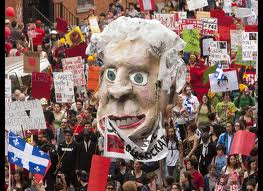
 Then you add hundred of police thugs who claim to love peace and order but really enjoy beating and abusing people for a living (because they are evil masochists). . . .
I think you get a fool who has over-played his hand

and a recipe for rebellion. . . . . . . .

What does one get when you take a conservative lawyer who become one of only two elected members of a party that experiences the worst defeat in British parliamentary history. . .
Then you add the greedy baby-boomer betrayal of a group of young people who want what their parents had and who understand that an attack on affordable education is an attack on everyone's future. . . .
Then you add hundred of police thugs who claim to love peace and order but really enjoy beating and abusing people for a living (because they are evil masochists). . . .I think you get a fool who has over-played his hand
and a recipe for rebellion. . . . . . . .
Sunday, May 20, 2012
The Gradual Unhinging of the Harpercons.
The central political question in Canada has lately become "just how far off the rails will the Conservative Party go?" For a long time political watchers have predicted the eventual self-immolation of Harper and his self-absorbed, bullyboy whackos. It was clear to most of us that once these guys got a majority they would begin to go off the deep-end. They have long been peddlers of hate who are so wrapped up in their own state of bizarre paranoia that it is nearly impossible for them to see clearly let alone engage in any sort of 'normal' political discourse. But while in a minority government they were able to create a sort of barricade mentality in which they could portray themselves as under siege by a hostile media and 'coalition' that was always waiting in the wings take over. It was obvious to everyone that this story would wear thin pretty quickly in a majority situation (particularly when every newspaper in the country except one endorsed them). However, not only did their story wear thin, a majority has made the Harpercons careless and pompous, with feelings of invulnerability and entitlement. As they have grown comfortable in their ministerial offices and limousines (like so many governments have in the past), they have begun to give up on any pretence to legality. Ministers like John Baird blatantly use their influence to divert funds to their friends, and seem entirely unconcerned that their malfeasance might be discovered. And under these circumstances ministers begin to reveal things that they would normally hide, feeling (as most tyrants eventually do) that their power entitles them to do as they please with public funds and ministerial power. As Susan Delacourt points out, they have begun not only more careless, but more childish as well. And as Lawrence Martin demonstrates, government ministers are beginning to come unhinged.
As they further entrench their power and get more comfortable in their positions (which will eventually bestow upon them the kinds of pensions that most Canadians can only dream of), the real problem for the Harpercons is that their hate and paranoia will become part of their everyday surface behaviour and that they will slowly become so despised by the vast majority of voters that they have no chance of ever winning an election again. Of course, this will be when they will become most dangerous. In the face of inevitable electoral defeat, Harper and his minions will look for ever more corrupt and illegal ways of maintaining their power and will slowly become like Putin in Russia, operating in total corruption while maintaining all the while that they are continuing to operate in a democracy. Paranoid tyrants are never so dangerous as when they become unhinged, and the hinges are breaking folks.
The real question in Canadian politics has now become "just how crazy will the Harpercons become?"
As they further entrench their power and get more comfortable in their positions (which will eventually bestow upon them the kinds of pensions that most Canadians can only dream of), the real problem for the Harpercons is that their hate and paranoia will become part of their everyday surface behaviour and that they will slowly become so despised by the vast majority of voters that they have no chance of ever winning an election again. Of course, this will be when they will become most dangerous. In the face of inevitable electoral defeat, Harper and his minions will look for ever more corrupt and illegal ways of maintaining their power and will slowly become like Putin in Russia, operating in total corruption while maintaining all the while that they are continuing to operate in a democracy. Paranoid tyrants are never so dangerous as when they become unhinged, and the hinges are breaking folks.
The real question in Canadian politics has now become "just how crazy will the Harpercons become?"
Saturday, May 19, 2012
Bill 78 and the Slow Decline. . . .
If there were any doubts in your mind that we are inching our way toward a police state, there can surely be no doubt left after this week's passage of Bill 78 in Quebec. That part of the Bill that deals with public demonstrations is a deeply draconian measure that effectively puts an end to the very notion of public opposition. As written the Bill necessitates that anyone who wants to engage in a political demonstration of more than ten people must notify the police eight hours in advance, indicating place, numbers, and destination of the demonstration if it proposes to occur in more than one place.
Most police states in the world have such laws which are de facto meant to make political demonstrations illegal. The police appear to have the power under Bill 78 to exercise prior restraint concerning any demonstrations and can effectively keep any demonstrations (which they allow to proceed) away from any place that might be deemed 'politically sensitive.'
What Bill 78 really means is that if you and nine friends get together in the park to enjoy the afternoon and someone starts talking about politics, you can be arrested. Sound melodramatic? It's not. Just open a history book and read about how police-states have emerged and you will see that when it starts it all sounds innocent and harmless, and is always deemed necessary by the governments involved.
Our governments are full of hypocrites. They cry indignantly when citizens of Syria and Egypt are subjected to government oppression, but they don't miss a beat in oppressing their own people. Remember when Stephen Harper was the leader of the opposition and never tired of criticizing the Government of China for its oppressive practices? As Prime Minister he is a great advocate of those very practices as he guts our own human rights laws, seeks to fill the prisons, wants access to your home computers, and slowly shuts down any and all opposition. And Mr. Charest (like so many Liberals) is nothing more than a mindless follower of Harper's draconian ideology.
Most police states in the world have such laws which are de facto meant to make political demonstrations illegal. The police appear to have the power under Bill 78 to exercise prior restraint concerning any demonstrations and can effectively keep any demonstrations (which they allow to proceed) away from any place that might be deemed 'politically sensitive.'
What Bill 78 really means is that if you and nine friends get together in the park to enjoy the afternoon and someone starts talking about politics, you can be arrested. Sound melodramatic? It's not. Just open a history book and read about how police-states have emerged and you will see that when it starts it all sounds innocent and harmless, and is always deemed necessary by the governments involved.
Our governments are full of hypocrites. They cry indignantly when citizens of Syria and Egypt are subjected to government oppression, but they don't miss a beat in oppressing their own people. Remember when Stephen Harper was the leader of the opposition and never tired of criticizing the Government of China for its oppressive practices? As Prime Minister he is a great advocate of those very practices as he guts our own human rights laws, seeks to fill the prisons, wants access to your home computers, and slowly shuts down any and all opposition. And Mr. Charest (like so many Liberals) is nothing more than a mindless follower of Harper's draconian ideology.
Wednesday, May 16, 2012
Just Take Any Job . . . (How about Revolutionary Leader?)
In a way I am happy that Jim Flaherty, that sad, pathetic, incompetent, shell of a man, has told Canadians that they just need to stop complaining and take any job they can get. I am glad because Mr. Flaherty's statement is a de facto admission that this government has no interest in creating a modern, dynamic, forward-looking economy. Rather, this government is on the path to the third-world economy where the rich are getting richer and the rest of the people can just piss up a rope for all the government cares. Despite the continual refrain that we hear from the Harpcons that their government is all about jobs and growth, they (along with their neo-con associates globally) have taken the most prosperous economies in the world (at a time of unprecedented wealth) and managed to throw most of the working population under a bus, relegating us and our expectations to McJobs for the rest of our lives. At a time when the rich have never been richer, Mr. Flaherty is telling you to go out and just deliver pizzas because that is all Canadians are really worth.
Gone are the days when governments spoke inspiring words of hope (remember this is the Finance Minster who actually publicly eschewed investment in Ontario). If our government was a parent it wouldn't be the type who says "I have faith in you, you can go out and do anything you want with your life! No goal is to big!" Rather, this government would be the type of parent that said "Forget college or university, you are never going to amount to anything anyway. Just go out and take the first job that comes along and be thankful you could get that."
What Mr. Flaherty inadvertently did when he told Canadians to just take any job was admit that his government is not really about making a better future for you and your family. His government is about repressing wages so that corporations can make more money while you and your family wallow in poverty. Little did most people know that when Harper says his government is all about "jobs and growth," what he really meant was his government is all about "bad jobs and growth for corporate balance sheets."
Gone are the days when governments spoke inspiring words of hope (remember this is the Finance Minster who actually publicly eschewed investment in Ontario). If our government was a parent it wouldn't be the type who says "I have faith in you, you can go out and do anything you want with your life! No goal is to big!" Rather, this government would be the type of parent that said "Forget college or university, you are never going to amount to anything anyway. Just go out and take the first job that comes along and be thankful you could get that."
What Mr. Flaherty inadvertently did when he told Canadians to just take any job was admit that his government is not really about making a better future for you and your family. His government is about repressing wages so that corporations can make more money while you and your family wallow in poverty. Little did most people know that when Harper says his government is all about "jobs and growth," what he really meant was his government is all about "bad jobs and growth for corporate balance sheets."
Friday, May 11, 2012
MP Bruce Hyer's Confusion. . . . .
MP Bruce Hyer recently quit the NDP caucus and decided to sit as an Independent MP. In an article Mr. Hyer explains his resignation from the NDP caucus saying "I wil no longer belong to any party that "whips" (mandates) voting by their MPs, especially on issues not clearly laid out in agreed-upon written policies or platforms. Which mean that none of the main political parties is currently an option for me." Mr. Hyer laments that our current system leaves "little room for meaningful public debate . . . or for putting constituents ahead of party politics!" (Notice the accentuation of his disgust and determination with the well-placed exclamation mark.)
Now, these are common laments among many Canadians (as it was so markedly expressed by the members of the so-called "Reform Party") and Hyer points out that Canadians "share" his disillusionment. I understand, to a degree, Hyer's frustration (though it seems odd that he would be join an organization which had these rules of which he was entirely aware going in), but the problem is that his solutions to the problems that he thinks plague our system are meaningless at best, and strangely contradictory at worst.
Mr. Hyer sets out four primary solutions to our parliamentary problems; Randomizing Seating, Riding Level Candidate Approval, Collaboration Between Parties, and Proportional Representation. Now, his idea of randomizing the seating in the House of Commons sounds fine. However, this is effort in itself would probably be entirely cosmetic and would solve nothing as long as our political culture continues they way it is. Hyer's third solution "Collaboration Between Parties," similarly sounds good but is really just an echo of Rodney King's famous dictum "can't we all just get along."
These two idea are hardly controversial, but neither are they very meaningful either.
Mr. Hyer's other two solutions are much more problematic because their nature seems to contradict the very premises from which Hyer begins. For a start, the ideas of "Riding Level Candidate Approval" and "Proportional Representation" contradict each other. Though there exists a number of so-called 'mixed PR' systems in which there are some individual ridings while the rest of the MPs are simply representatives of the "party," overall PR generally eliminates the whole idea of 'ridings,' let alone candidate approval at the riding level. The thing is that Mr. Hyer seems to be suffering from a basic POLI-SCI 101 misunderstanding (or he simply hasn't explained himself adequately). Mr. Hyer's desire to truly represent his constituents rather than expressing the "mandate" (his word) of his party points away from Proportional representation rather than toward it. The US system is a case in point - there is almost no system of party discipline in the the US Congress and members vote however they want on any given issue. When a member of parliament is elected under a system of PR their constituency is spread out throughout the nation because they consist of all the people that voted for that party. Thus under PR individual MP almost always vote for the party they were elected to represent. If Mr. Hyer really wants to represent his individual riding he should be arguing for a system more like that in the US rather than for a more Proportional system.
(I am not getting into an argument about PR here. I am an advocate of PR but I know that it has its drawbacks. I just happen to believe that its advantages outweigh its failures. I also believe that we can create a mixed PR system which has some of the advantages of both First Past the Post and PR.)
Mr. Hayer seems to be quite confused. If he wants to work for PR and a more democratic system, that's great. But he surely should have known how our House of Commons works before he got there and I am mystified by his apparent surprise. However, if Mr. Hayer's primary concern is the representation of his constituents in Thunder Bay-Superior North, it is not PR he should be fighting for - it is the renewal of the unfulfilled dream of the Reform Party to eliminate party discipline (a principle which that Party never lived up to).
Now, these are common laments among many Canadians (as it was so markedly expressed by the members of the so-called "Reform Party") and Hyer points out that Canadians "share" his disillusionment. I understand, to a degree, Hyer's frustration (though it seems odd that he would be join an organization which had these rules of which he was entirely aware going in), but the problem is that his solutions to the problems that he thinks plague our system are meaningless at best, and strangely contradictory at worst.
Mr. Hyer sets out four primary solutions to our parliamentary problems; Randomizing Seating, Riding Level Candidate Approval, Collaboration Between Parties, and Proportional Representation. Now, his idea of randomizing the seating in the House of Commons sounds fine. However, this is effort in itself would probably be entirely cosmetic and would solve nothing as long as our political culture continues they way it is. Hyer's third solution "Collaboration Between Parties," similarly sounds good but is really just an echo of Rodney King's famous dictum "can't we all just get along."
These two idea are hardly controversial, but neither are they very meaningful either.
Mr. Hyer's other two solutions are much more problematic because their nature seems to contradict the very premises from which Hyer begins. For a start, the ideas of "Riding Level Candidate Approval" and "Proportional Representation" contradict each other. Though there exists a number of so-called 'mixed PR' systems in which there are some individual ridings while the rest of the MPs are simply representatives of the "party," overall PR generally eliminates the whole idea of 'ridings,' let alone candidate approval at the riding level. The thing is that Mr. Hyer seems to be suffering from a basic POLI-SCI 101 misunderstanding (or he simply hasn't explained himself adequately). Mr. Hyer's desire to truly represent his constituents rather than expressing the "mandate" (his word) of his party points away from Proportional representation rather than toward it. The US system is a case in point - there is almost no system of party discipline in the the US Congress and members vote however they want on any given issue. When a member of parliament is elected under a system of PR their constituency is spread out throughout the nation because they consist of all the people that voted for that party. Thus under PR individual MP almost always vote for the party they were elected to represent. If Mr. Hyer really wants to represent his individual riding he should be arguing for a system more like that in the US rather than for a more Proportional system.
(I am not getting into an argument about PR here. I am an advocate of PR but I know that it has its drawbacks. I just happen to believe that its advantages outweigh its failures. I also believe that we can create a mixed PR system which has some of the advantages of both First Past the Post and PR.)
Mr. Hayer seems to be quite confused. If he wants to work for PR and a more democratic system, that's great. But he surely should have known how our House of Commons works before he got there and I am mystified by his apparent surprise. However, if Mr. Hayer's primary concern is the representation of his constituents in Thunder Bay-Superior North, it is not PR he should be fighting for - it is the renewal of the unfulfilled dream of the Reform Party to eliminate party discipline (a principle which that Party never lived up to).
Subscribe to:
Posts (Atom)


