Tuesday, November 1, 2011

Whither Greece?

Anyone who has been a close observer of democracy knows that Western countries have only ever been committed to democratic principles to the degree to which they support and strengthen Western (generally capitalist) interests. Western countries love to talk about democracy but when they don't like the results that a democratic process promotes they quietly (or sometimes loudly) ignore or condemn the process. From the early days of the Trilateral Commission worrying about "too much democracy" to the election of Hamas, the West shows itself again and again to be interested in democracy only to the degree that it promotes their interests. Recently our own government in the past several years has done everything in its power to avoid established democratic processes and principle.

This anti-democratic tendency among the world's nations and the capitalist elite was on full display today when Prime Minister Papandreou suggested that his nation should hold a referendum on the policy that will have perhaps the greatest effect of any legislation on Greece for a generation, and governments and capitalist around the world reacted with disgust and panic. Imagine letting the people decide on something so important. Now, I am not naive and I know that there are cases in which so-called direct democracy can be a problem. But the cases in which democracy can be overridden are those in which the rights of the few are going to be overridden by the bigotry of the many. Federal and supreme courts in many countries can override democratically elected governments in cases such as human rights in which the majority is attempting to prevent certain people in society from enjoying equal rights. Such cases have been seen in things like so-called "interracial" marriage or gay marriage. Furthermore, I am sure that there are cases in which the "people" do not act in the real, longterm interests of the nation. However, in the case of Greece we have a nation that has been pushed to the brink by the irresponsibility of the banks and by a deeply corrupted taxation system in which the rich and corporations have paid almost no tax for decades despite so-called 'socialist' governments. Now, even though they have been paying for generations, the people are once again being asked to bear the brunt of the rich exploiting the system in their own interests. Bankers, large market investors, and the rich in general dread the idea that Greece or any nation could ask the people what is right and wrong when it comes to economic interests. This is what capitalists have always feared. But socialists (and in the old days even Liberals) have been saying for a long time, the economy is hear to serve us not the other way around, and if we decide that banks or capitalist shouldn't be allowed to act in certain ways then frankly that is just too bad for the banks. Despite what rightwingers might tell you, corporations are NOT people and the people can control, and always have controlled markets in various ways. If the people of Greece reject a solution to an economic crisis entirely brought about by banks and the rich syphoning off billions of dollars that should be distributed more fairly throughout the economy - that is a victory for democracy, and those who fear it are those that fear democracy in its most basic and principled form.

UPDATE - Shortly after I wrote this our dear Finance Minister Flaherty responded to the issue of a referendum in Greece. Trying not to sound too outrageously anti-democratic Flaherty said "It is not for us to dictate terms to the Europeans." But he we went on to say that "delay endangers the global economy." The real message from the Harper Tories has consistently been that democracy is dangerous to THEIR goals unless they can get something out of it for themselves. Remember that this is the man who, as finance minister of Ontario left a six billion dollar deficit during a time of global prosperity and then tried to hide his incompetence during the election. Naturally, for this remarkable feat, Harper put him in charge of the nation's finances. 

Saturday, October 29, 2011

Whither the Arts?

Though I am closing in on fifty, by today's standards I know that I am not old. But of course, like many people in this age, the degree to which many aspects of society have changed, can make me feel rather older than my years. And it is not just the computer revolution and the end of so-called "communism" that make me feel a lot older than, say, a twenty-five year old who doesn't really remember the Soviet Union or a time before personal computers. But over and above the huge technological and political changes that have occurred over the past forty years, I believe I have seen a fundamental cultural shift relating to our aesthetic experience. Specifically the close of the 20th century witnessed the death (or dying process) of our traditional art forms, including painting, the novel, theatre, and to a certain degree much of what we know as music.

The explanation for this rather significant claim would, of course, take a great deal more space than what we have on a blog. But given enough space and time, I believe the claim is perfectly demonstrable and therefore justifiable. In the fifties Jean-Paul Sartre wrote a book that is seldom read today entitled Search for a Method. This book was intended as a conceptual introduction to his Critique of Dialectical Reason, a book that for most philosophers was never able to live up to the promise of its title. Anyway, Sartre's most interesting claim Search for a Method was the claim that there is basically only one living philosophy at any given time. Of course for Sartre the "living" philosophy (and keep in mind that this was written in the 1950s) was Marxism and that any anti-Marxist argument was, at best, a pre-Marxist argument. Though today Sartre's argument has a distinct subtext of Ethno-centrism, at the time (before the real linguistic turn in philosophy had taken effect) Sartre had a very good point. What interests me about Sartre's argument though is the degree to which it points to the "living" aspect of a philosophy. At the risk of paraphrasing a philosopher considerably more brilliant than I, Sartre was suggesting that a philosophy was only "living" during the period that other philosophies had not surpassed it and it still was central to the way that we define and understand our experience at the meta-social level. Now, obviously this is an extremely truncated argument that could fill an entire book. There are many potential points of argument but I think this sums it up enough that my handful of readers out there will get the point. For me Sartre's argument became important because I applied it to the life and death of art forms. Art forms are "living" while other art forms have not significantly surpassed them, while they still have new things to say, and while they continue to express and influence the ways we define ourselves as a society. It is by these standards that I believe the significant art forms of the past have. . . . well .. . . passed away. In the early twentieth century the Surrealists attempted to shift the way we look at visual and written art work. They tried to kill the novel because they essentially thought it was a dead art form. The story of the relationship between the Surrealists and the novel is a long and complex one, but I believe that men like Andre Breton and his various followers in the literary movement of Surrealism had a lot to say to us about literature. But people were not really listening because there continued to be a significant profit in the bourgeois novel and the "literary industry" was bound to keep it alive. I have said before, and received much abuse and derision for the claim, that the novel as an art form reaches its apex around the time of Proust. Proust took the psychological aspect of the bourgeois art form of the novel to it complete and somewhat ridiculous conclusion. After the era of the Surrealists and Proust, I think the novel is just in the period of denouement, if you will pardon the expression. (Though I think one can mount an argument that so-called Magic Realism and some science fiction such as the work of Samuel Delany,  are genuine steps in the development of the novel) But in general I think all the art forms that were still so important at the beginning of the 20th century were more or less deceased by the beginning of the 21st century. Not only have the models and markets changed, but technology has rendered the old art forms largely mute.

When I was silly enough to talk about these things in public, people usually reacted to these claims with a pretentious smirk as though to say that either I had no idea what I was talking about or that if I were an artist or a writer I would know better. Of course, I am now both a professional writer and painter and I am more convinced than ever that my opinion on this matter is correct. I have my own personal reasons for being an artist and a writer and it doesn't really trouble me that traditional arts form have largely died. I can live with the status of being an anachronism. But the university educated, cultural consumers of any age are loath to give up their traditional art forms because it is these that they believe separate them from the hoi polloi. These people would never, of course, admit that a major aspect of their attachment to certain art forms is actually a way to express their elitism. Many of them consider themselves enlightened and even leftwing and they sit in their well-decorated, intercity, red-brick houses reading novels that 90 percent of people couldn't care less about and they secretly love the status that they believe themselves to possess. But really they are just feeding on the corpse of a bygone era.

Friday, October 28, 2011

The Looming Crisis. . . . .

Every instinct I have suggests to me that we are entering a time of a crisis of capital similar in form, if not content, to the crisis that gripped it in the nineteen thirties. Just as the depression in the thirties was brought on in part by the over-confidence and irresponsibility of the capitalist elite, this crisis is rooted in the same kind of problem. Globalization of capital and industry, the radical expansion of corporate profits, the growth of extreme and lopsided wealth of the top 10 or twenty percent, the stagnation of real wages for the vast majority, the manner in which large corporations act outside the law in many nations, put together these factors suggest a coming crisis. Of course, the necessary incendiary ingredient is dissatisfaction of the people at large. While the wealth of the corporation and the economic elite is skyrocketing, governments are pleading poverty and everywhere people are being asked to give up their pensions, decent wages, and any sense of security. People may be easy to con when they are feeling ok about things, but they will not be such obedient sheep when they are pushed into more poverty and insecurity.

Marx pointed out that a socio-economic system nurtures the system that will eventually come after it. At the present moment in history even a genuine capitalist must understand that international corporate capitalism is headed for a major problem if its leaders don't begin to ensure a greater distribution of wealth and system that makes people feel as though they are not simply the play-things of corporate power.

Unfortunately, a society's elite seldom sees a crisis coming and seldom gives up any of their power and wealth voluntarily. We shall see.

Letter to Rob F***king Ford. . . . .

Hello Mayor Rob F***King Ford,

Yesterday you released a statement  concerning the incident in which a great Canadian comedian attempted to have you take part in a time honoured tradition in Canadian Television. In your statement you said you called the police because you were "attacked" in your driveway.

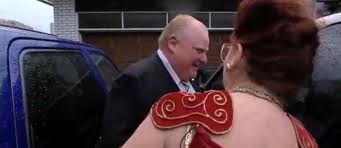
Well Mr. Ford, since you don't seem to know what the word "attacked" actually means I thought I would assist you with a couple of visual aids.

Mr. Ford, this is what it looks like when you are being attacked.


This, on the other hand, is not what it looks like when you are being attacked - 


Of course, Mr. Ford, since there is clearly a smile on your face in this picture, I suspect you really know the difference between being attacked and not being attacked. 


And since you have so much experience in verbally attacking and abusing others, the whole matter is actually very clear to you. Suddenly the overbaring, glib, bully of a man desperately wants us to see him as a victim because when you are out of your comfort zone you are actually a petty, cowardly little man who fears, perhaps more than anything, being questioned about your public persona. 

And that, Mr. Ford is, as they say, that. 


Thursday, October 27, 2011

Abusive Behaviour and the Mayor of Toronto. . . . .

Can anyone out there seriously say that they are surprised by Robert Ford's abuse of the hardworking 911 operators? After all, we knew what kind of man Mr. Ford was before he was elected to be Mayor of Toronto. Ford is a self-absorbed, bully of a man who seeks for recognition by attempting to make people afraid of him, by belittling others in order to compensate for his own shortcomings as a man and a human-being. People who lack compassion and genuine human feeling find it difficult to comprehend why people do not conform to their wants and desires, somewhere deep inside them they are frustrated by their own lack of human connection and the only way that their truncated souls can react to their frustration is to lash out in an, often futile, attempt to force others to conform to their will. Lacking a basic level of humanity, these sad individuals are vaguely aware of their shortcomings and the only way that they can deal with it is by attempting to lower others through violence (verbal and physical), thus attempting to trick their psyche into believing that they are superior to those around them. This is central to Mr. Ford's behaviour at all times, as it is with so many rightwing politicians. This is why the natural consequence of a certain brand of rightwing politics is fascism. Stephen Harper is a similar man to Robert Ford, though with a considerably greater degree of self-control. Such men (and occasionally women) are not connected to other human beings at a basic emotional level and therefore the only thing that they can understand is control. And, of course, lacking empathy, such people are very seldom able to form meaningful alliances or create significant loyalty from others. If your modus operandi is power and abusive control, people only care about you to the degree that you can wield power or use your power to assist them in some way. In other words, to borrow from Kant, if you treat people as a means to an end, they will treat you the same way. This is why such autocratic leaders so often fall suddenly and inauspiciously - because once power is gone they have nothing, and no one to depend upon.

In Ottawa we had a mayor with a similar style to Mr. Ford, though not quite as bad or obtuse. Mayor O'Brian went down to ignominious defeat because he didn't how to deal with people at a basic human level. He was able to use his self-centred, abusive style to gain success in the business world so he assumed that it would translate directly into the job of mayor. Mr. Ford had a certain degree of success as a councilman because in this position he didn't depend on the goodwill of his coworkers - he could be the squeaky door of the council, gaining attention and bemusement as he went. But when you put such a man in a position of significant power, it is a disaster waiting to happen. I wouldn't be surprised if Ford fails to complete his time in office because at some point his abusive ego will carry him too far. Mr. Harper will go the same way at some point and history will judge him very badly. When I was young I said it about Nixon, in the 80s I said it about Thatcher and Mulroney, and I say the same about Ford and Harper. Unfortunately this abusive, philistine, angry personality sometimes carries people to power and maintains them there for a while. But it almost always ends badly. And it is not just an issue of right and left wing. Take John Tory in Ontario for example. I disagree with most, if not all, of Mr. Tory's ideological beliefs. But he treats people with a significant degree of respect, listens to the arguments of others, and doesn't depend upon abusive power-mongering to stake out his beliefs in the public realm. Of course, just as abuse can lead people to power, respectable behaviour can prevent you from gaining power. However, while John Tory still has the respect of his allies and his opponents, Mr. Ford is quickly losing the respect of everyone.

Wednesday, October 26, 2011

NDP Blogging site goes Offline. . . .

I was very sorry to see the NDP Bloggers site go off line. It seems odd that at a time when the NDP has never been stronger, their primary online voice has been silenced. If I were a conspiracy minded person I would say that insiders at the NDP, such as those that might favor the victory of one of the two most high-profile candidates, have intentionally put a stop to it. The good thing about the NDP Bloggers site was that it was an independent voice of fellow travellers and in a leadership race many of the bloggers were looking at alternatives to Mulcair and Topp. Not that I think the bloggers were necessarily going to make a big difference in which leader got elected, but it is one more area of debate that has been closed down in the lead up to the vote.

It seems strange that the Liberals who have a fraction of the seats in the House of Commons  can maintain a very strong internet blogging site but the NDP, as soon as it gets close to power, suddenly cannot. Coincidence? I find it difficult to believe. It will definitely be harder to get a sense of what people who are sympathetic to the NDP are thinking.

Sunday, October 23, 2011

Karzai's Rejection and Geo-Politics. . . . .

Well the chances of a war between the US and Pakistan are probably considerably less than zero percent. However, those ridiculously long odd do nothing to dampen the supreme irony and humor in the recent revelation of Afghanistan's President Karzai that if such a war were to erupt, Afghanistan would be squarely on the side of it's neighbouring Islamic nation against the world's only so-called 'super-power.'  One cannot help but wonder how this revelation must play in mainstream America among those poor ignorant souls who bought into the neo-colonial spin, so prevalent in the US and elsewhere, that the invasion of Afghanistan was an act of benevolence, or at the very least 'self-defence.' History will, of course, read it differently. All colonial efforts, whether traditional or economic, are accompanied by some grand narrative of benevolence and defence. The real motivations of such efforts are, of course, geo-political power and economic interest. But to the average American (or Canadian for that matter) who doesn't understand the complex economic and political issues behind the spin, Mr. Karzai's words must send their heads reeling. For most Americans, steeped as they are in the professional ignorance peddled by Fox News and friends, this must sound like Charles De Gualle telling the New York Times that he would support Hitler after D Day. Of course the comparison would be specious but this is the kind of thing that goes on inside the head of people that fail to take a realistic view of geo-politics.

The reason that Karzai would say that he would, in a conflict situation, come to the aid (however minimal it would be) of Pakistan against the US is that the United States never built up any so-called 'good-will' in Afghanistan, whether among the people in general or the brutal tribal lords who still govern the nation. For all its fancy, completely fictional, spin, the US's invasion of  Afghanistan was part of a multi-pronged effort at consolidating its waning power in West Asia and the Middle East and to entrench the dominance of weapons and security corporations within the United States, a symbiotic relationship that was coming under threat with the end of the Cold War. Year in and year out, the lion's share of US federal spending finds its way, through one door or another, into the pockets of Weapons producers or private security companies. The American establishment knew that this relationship had become tentative an increasingly difficult to justify during the 1990s but the invasions of Afghanistan and Iraq  made this huge transfer of cash from average tax-payers to large corporations once again unquestionable. However, like most colonial or neo-colonial powers, the US forgot basic lessons of the past and failed to maintain good-will with those on whom their basic geo-political plan depended. In other words, as is their history, they didn't take care of 'the people,' but they also failed, as they once did so effectively, to establish an adequate strong-arm regime on who they could depend for blind obedience. In the long run this means real trouble for the US as their global power slowly dissipates and their ability to compel nations to do their bidding with their economic power disappears.

 For example, for several generations the US has had a vested interest in conflict between Israel and the Palestinians. This is because while the Palestinians pose no real threat to the US or Israel, the conflict gives the US government a ready-made excuse for the billions and billions that it gives to Israel, thus further justifying their militarist economy. But Mr. Karzai's rather blatant rejection of the US in the recent interview, suggests that time is running out for the US and its Allies; they are gradually losing their grip on their once unquestioned global dominance, but they are also running out of the economic clout to enforce their control. Unless they fundamentally change their basic strategy the US will gradually lose its ability to maintain any serious control over any country and they will be forced either into an extreme fascist reaction or a new conciliatory policy that looks for peace and economic cooperation. If Mr. Karzai is any indication of their job so far, the US, and the West in general, is in serious trouble.