Friday, September 18, 2015

The Debate and Vision. . .

I wonder what people will make of the G&M's David Parkinson's article on Justin Trudeau this morning. Is this a sign of things to come? The thrust of the article is that Trudeau is the only of the three main leaders who is offering something new, something that challenges some of the economic assumptions that have constituted the mainstream for the past decade. (Of course, Parkinson's failure to mention Elizabeth May and the clearly new challenge that the Green Party represents is both predictable and unfortunate.) However, if we stick to the established parties, there is certainly something in what Parkinson has to say.

Parkinson's best insight, though very limited in scope, is when he challenges the real meaning behind Harper's economic efforts. When thinking about Harper's effort to lower taxes and balance the budget, Parkinson asks "So what was the point?" Good question I'd say. "If we imagined that these were means to an end, that once achieved there would be a grand plan cashing in the dividend from all that hard work, we were wrong." Wrong indeed! This is because the simple fact is that the ends to which Harper's Neo-Liberal policies are directed are not a better and more prosperous society, but rather, greater wealth for the rich and corporations, deeper economic inequality, and a more precarious workforce with less leverage to make demands. If Parkinson understood this, he would never expected any pot of gold at the end of Harper's supposed economic rainbow. So, ten out of ten to Mr. Parkinson for seeing the dearth of reward from Harper's effort, but minus a few million for failing to understand the real economic goal here.

Parkinson is right in part when he concludes his article with the observation that among the big three, "only Mr. Trudeau offered a vision of something new." Now, before people go crazy telling me that Trudeau represents the same old Neo-Liberal agenda that was begun my the Chretien/Martin Liberals, let me clarify this. One of the primary thrusts of new economic ideas (publicly spear-headed in part by writers like Thomas Pikkety) is the need for huge infrastructure investments in order to ensure the future of Western nations whose primary post-war investments in this area have now broken down. Part of this argument is that the huge infrastructure investments of the post-war period were one of the primary factors in the long-boom that ended in the 1970s. Since then the Neo-Liberal agenda has allowed this infrastructure to slowly wither and die, keeping it alive only by a patchwork of bandaid solutions. In this sense there is something very important in what Trudeau is saying. And the Liberals are in part also right when they say that you can't have a Tommy Douglas expansion on a Stephen Harper budget. The great infrastructure investments were made at a time of much higher taxation and much higher government revenue vis-a-vis GNP.

Thus, I would say that there are two important ways that the NDP has ceded progressive ground to the Liberals. One is that they have talked even less than the Liberals about the environment in an election where the environment has been conspicuously absent. And two, they have failed to take on board even the mainstream economic thinking which is making infrastructure investments central. New clean-energy technologies, a revitalization of our education system, huge reinvestments in our healthcare, any visionary politician must make these the absolute core of the way forward. If Thomas Mulcair believes in any of these things he certainly hasn't articulated them adequately. Meanwhile, by not getting bogged down in anti-deficit fetishism, Trudeau is scoring real points in the 'vision' department.

Monday, September 14, 2015

Walter Benjamin and the Refugee Crisis. . . .

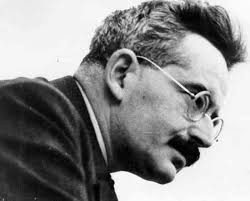
In the early 1930s, refugees began to leave Germany. The lucky and smart intellectuals, communists, Romany, and others saw the writing on the wall and knew that they were in danger if they stayed on. The luckiest and smartest had begun to flee before Hitler became chancellor in Jan. 1933. The decline toward fascism was initially creeping and unclear to many. (As is true today, funny enough.) One of the most historically interesting of these early refugees was a little known, though academically well connected intellectual named Walter Benjamin. Today Benjamin is one of the most widely read and influential theoretical writers in 20th century humanities, but in his own lifetime he lived in relative obscurity, in part because, so the story goes, the philosopher Max Horkeimer had intentionally prevented him from receiving a PhD.  I have read much of Benjamin's work and find him fascinating and challenging.
Walter Benjamin

Benjamin left Germany in 1932. After moving around a bit he eventually ended up in Paris in self-induced exile because as a jew, an intellectual, and a leftist, he knew that he couldn't co back to Germany. During his time in Paris he laboured on his most remarkable work entitled The Arcades Project, a huge tome of theoretical and literary snippets on every subject from Baudelaire to Surrealism.

Benjamin was finally forced to flee Paris in June of 1940 as the Panzers descended on the Capital. He had left his unfinished manuscript of The Arcades Project with another remarkable intellectual, Georges Bataille. Benjamin managed to leave only a day before the Nazi's arrived with orders for his arrest. Benjamin was planning to get to American via Spain and then Portugal. He made it across the French-Spanish border but the Franco government had suddenly cut off the Portuguese frontier to refugees. There were rumours that the Spanish police were going to arrest Benjamin, along with numerous other refugees that he was with, and deport them back to France, where he would certainly have fallen into the hands of the Nazis. To avoid that terrible fate, Benjamin took a fatal overdose of morphine on the 25th of September 1940, he was forty-eight years old. Considering the remarkable power and acuity of his work during his 30s and 40s, we can assume that had he lived, he would have been one of the greatest literary and aesthetic theorists of all time.

During the pre-war and interwar years Western nations took in many refugees. Some of these were or turned out to be important intellectuals, artists, and scientists. Others were just average people who wanted to live their lives, in as happy and peaceful surroundings that they could. Unfortunately, some refugees were turned away or prevented from leaving and payed with their lives. Perhaps the most famous of those that were turned away were the 900 on board the Ocean Liner MS St. Louis who were turned away from Cuba, The United States, and Canada, despite the authorities knowing full well what was going on in Germany and what their fate might be. Many of the passengers on the MS St. Louis eventually died in concentrations camps, a sad and inconvenient truth we would do well to remember today. Whenever I hear about the refugee crisis in the Middle-East and Europe I think about Walter Benjamin. This is not because I put more value in intellectuals than other people. Rather, I think about Benjamin because it reminds me of the lives that potentially go unfulfilled, the promise of life that all those people fleeing war are hoping to enjoy, but might not be able to. I think about all those people who could, in a million different ways, make a contribution to our lives, to my life, if only our elected officials would make an effort to act as swiftly as possible.

Little Alyn Kurdi, the boy who we all saw dead on a Turkish beach a little more than a week ago, might have gone on to cure cancer, or he might have gone on to be a school teacher, or perhaps a humble tradesman. But whatever he might have gone on to do with his life, he would have laughed and cried, sang and danced, loved and lost, and enriched the lives of those around him. When we think of the refugees fleeing war today, I hope we don't think in the abstract. I hope we think of real, concrete human beings who don't just deserve to live decent lives but who we deserve to have among us because they can make us better, more fulfilled people.

Sunday, September 13, 2015

The Facebook Problem. . . .

Imagine, if you will, young men like Stephen Harper or Jason Kenny (gasp!) growing up today in our present atmosphere of technology. Try to picture what such mens' internet profile might look like. Take Jason Kenny - an angry, sexually ambiguous, Catholic, college drop-out. Just imagine what sorts of angry highschool and college tweets and Facebook posts would come from this social misfit's hands. It is relatively easy to hold back one's angriest and offensive opinions once you are in power. Loose mouths, as they say, sink political ships. And the pleasures and comforts of power are often instinctively protected once they are enjoyed. Not so youthful anger and angst. Some people are naturally discrete and reticent to say too much. Not men like Jason Kenny or Stephen Harper. Given an open forum to vent their youthful acrimony and annoyances, many such men (and women) would be hard-pressed to curb their enthusiasm, so to speak.

This brings us to the oddly 21st century political dilemma. Let's call it 'The Facebook Problem.' If the election in Canada that we are now going through is an historical indication, The Facebook Problem is the most pressing new dilemmas facing political parties. Most people who have grown up in the last fifteen years have a significant internet profile, and angry young people doubly so.

Few young people are they types who are thinking carefully ahead concerning their career. Only the most cautious and reticent young person is going to hold back their political and social passions because they think that they may have a public career in the future. And do we really want these kinds of people to be our leaders? We want passionate and inspired people in public life. Some of the things from peoples' past clearly makes it difficult to see them becoming elected officials. Pissing in cups or making racist rants are difficult things to get past or forgive, even when the person apologizes and says that they are 'reformed.' Other issues are much more subtle. When someone has simply expressed a legitimate political position but done so carelessly or even offensively, that is not something that shouldn't preclude them from public office. More importantly, The Facebook Problem (as well as the wider issue of media and technology) is making political parties extremely sensitive to any kind of dissenting opinions. The extreme lengths to which Harper has gone to muzzle nearly everyone in his party demonstrates the danger of this phenomenon. Meanwhile, in the US the Trump phenomenon demonstrates the potential backlash against overly rehearsed and controlled politics.

I see no ready solution to the Facebook Problem. Obviously encouraging people to express the worst kinds of offensive opinions is not the kind of solution one would want to promote. Where we go from here is anyone's guess.

Saturday, September 12, 2015

The Tragedy that Will Return Harper to Office. . . .

We are eager to write off Harper and his government as dead in the water. We were especially eager to write them off after their reaction to the tragedy of the refugee crisis in Europe. Harper's effort to change the channel on the terrible hardships of the refugees fleeing the Middle-East and North Africa and to focus on his war and his "security" concerns is both monumentally frustrating and deeply sad.

Harper's position is frustrating for the following reasons -

1.Canada has almost nothing to contribute to the military effort against ISIS. The current military effort against ISIS is nearly completely pointless anyway. The very best you can argue (and this is pretty thin) is that the bombing campaign can slow ISIS down, but it will by no means stop it. The proof of this is in the pudding, so to speak. The allies have dropped thousands and thousands of bombs and ISIS is as strong as ever and in some areas has made gains. And even if the bombing was working Canada has VERY little capacity to contribute to this bombing campaign in the first place. I think you might make a cogent argument that a military element is necessary in the fight against ISIS but it would involve soldiers on the ground, and Canada has even less ability to contribute to that campaign than they do to the bombing campaign.

2. ISIS largely exists because of Western adventurism in the region in the first place. (This is a long argument that deserves a book in its own right) However, even if that wasn't true in the past, ISIS is only able to maintain itself today because of support from a) the Saudi state and b) their oil sales. In both these cases the Western countries are culpable. The Saudi's (who largely responsible for 911) have been the primary backers of ISIS all along. The Wahhabi Movement that bolsters the Saudi Government is the same one that bolsters the fighters of ISIS. And even if we agree that the Saudi State is not actively involved with ISIS, it is actively turning a blind eye to its citizens who are. Meanwhile Canada and the US support the Saudi's in myriad ways. But the West is also turning a blind eye to ISIS's use of oil to fuel their fight. ISIS is smuggling oil through Iraq to Kuwaiti and Saudi refineries as well as into Turkey. The Western nations have made shockingly little effort to stop this smuggling because their allies are profiting from it.

Instead of worrying about more military involvement in the Middle-East, our country should be taking a much more active role in humanitarian efforts as well as diplomatic efforts at curbing conflict. Unlike the military adventurism, this would be an effort to which Canada could make a real and lasting contribution.

However, here is the saddest part. Far from seeing the refugee crisis as a negative for its effort a reelection, Harper and his conservatives are seeing it as the perfect opportunity to win. It is depressingly easy to exploit the deep-seated fear and bigotry at the heart of the Canadian public. And no one is more eager to exploit that fear and bigotry than Harper and his nasties. I believe that the terrible images of dead refugee children on Turkish shores was greeted with great relief by Conservative insiders because they knew that this was their perfect wedge issue that will carry them to another election victory. Over the next few weeks you will see discourse shift from concerns for the refugees to ever greater concerns for our "security" as the Cons exploit people's fear and racism. Far from reducing their support this will be a boon for the Conservatives. And Trudeau and Mulcair will whither before this onslaught as so many average Canadians will buy the spin of fear and let their basest instincts guide their voting hands.

I now predict the Cons will win another Majority government with somewhere around 38% of the vote.

God I hope I'm wrong.

Quick update - in the past week and a half (since the refugee crisis broke) Harper has gone up in the polls by several points. And is now in the lead for the first time. My prediction is already coming true.

Friday, September 11, 2015

They Think they Know What is Right. . .

As I drive through my neighbourhood, and a very conservative neighbourhood it is, I am struck by the shocking number of Conservative lawn signs that litter the roadway. It shocks me because, well, frankly I am always amazed that people are willing to support a political party after it has proven itself to be not only deeply corrupt but, in many ways, the very antithesis of what it claims to be. I don’t need to catalogue the litany of ways in which the Harper government has, over the past ten years, lied cheated and stolen its way through its time in power. If you are reading this you probably are already painfully aware of that dismal record. There are, of course, those out there who have no real idea of just how terrible and hypocritical the Harper government has been. Those people are, unfortunately, barely worth speaking to. If you have come this far and failed to see what has been going on, it is very unlikely that any amount of discourse will help you see the light. Some people are either too obtuse or too thickheaded to really bother with trying to understand what is going on in their society. So it goes.

These kind of know-nothings are depressing and frustrating but not as aggravating as those who know what is going on but still support the very things that they claim they oppose. Stupidity isn’t evil, even willful stupidity. It is either bred in the bone or grows out of fear. I don’t like it but I expect it, I understand it. What I have trouble understanding are those who know of corruption, of hypocrisy, of evil and dishonest deeds but still stand by their party. 

Anyone who has paid attention and understands the political, social, and economic system we live in, knows how corrupt and hypocritical the Harper government has been. So that leaves us with what should be a simple question – why do people do it? Why do they support a government that so willfully disobeys the laws?  The only answer that has ever come to mind for me is that partisans such as this operate on the simple assumption that it is ok to do the wrong things for the right reasons. Let me be clear, however, what the wrong things are. Most Conservatives don’t mind that Harper and his cabal sew the seeds of anger and hatred in their politics. A shocking number of Conservatives are motivated by a strange kind of anger and meanspiritedness in their politics. They believe that most people are out there being shiftless and lazy and trying to get something for nothing. They don’t mind, therefore, that Harper expends a tremendous amount of political capital hating on people, for want of a better expression. Thus, the “wrong-things” that Conservative partisans quietly rationalize to themselves (hoping no one will hear them) aren’t the nasty elements of their political machine. No, their rationalizations are about the basic political corruption that we have witnessed, the lying, the fraud, the secrecy, the bending of the rules in the House, the shutting down of debate and discourse, all of those things that the Conservatives told us that they didn’t stand for. Conservatives figure that they can engage in all these acts of dishonesty and malfeasance because the principles of democracy basically thwart their goals, because people are too weak and too unwilling to do the things that they must and democracy will allow them to too closely follow their heart and their compassion. Conservatives, therefore, believe that in the long run it is ok to sidestep democracy, to rationalize lying and corruption because in the end it will work out for the best. This is, in simple terms, why so many people are willing to overlook the worst deeds of their party leaders.


If Harper’s terrible cabal gets reelected it will be because of a combination of basic human stupidity, the angry motivation of much of rightwing politics, and basic (largely immoral) notion that the ends justify the means.

Thursday, September 10, 2015

Harper and his Future Image. . . .

By the evidence offered in his latest article for McLean's Magazine, writer Paul Wells is engaging in significant hallucinogenic substance abuse. What else could possibly explain his bizarre attitude toward Stephen Harper's recent behaviour. His article is, for the most part, uninspired an uninteresting. Despite all appearances to the contrary he claims that Harper has been, on this campaign trail, a brighter and bubblier character than he has ever been before.  He claims he is having a rip-roaring time out there on the hustings. "He stands straighter, delivers his lines with more élan, and seems in a far better mood than four years ago, when he slouched and grumbled his way to a third consecutive election victory." I don't know about you guys, but having watched this Prime Minister carefully four years ago as well as in the past few weeks, and I can only think that Paul Wells has been dropping some acid or overdosed on his prescription of Xanax.

But I maybe Wells is only engaged in some wishful thinking enhanced by some excessive intake of caffeine on the campaign trail.

What is even more bizarre than his image of a happy-go-lucky, devil may care sort of Harper, is his notion that Harper has been a leader who has been carefully considering his legacy and his future image in this country. "But, unlike most leaders," Wells tells us, "Harper has grown used to thinking of his party's future after his own leadership ends."

Ok, upon reading this line this morning, I almost lost by breakfast through my nose! I can think of no political leader in the past forty years who has thought less about his party's future than Stephen Harper. First of all he has successively and intentionally filled his cabinet with people who are barely competent, comically obsequious toward him, and have been systematically starved of leadership chances by Harper's centralizing control. Harper has clearly operated on the assumption that if he keeps potential leadership challengers out of the way, he will last longer as leader. In other words, instead of thinking about his party's future, Harper has always made a very clear effort to make himself the party, to make the party so dependent upon him that at the point of his eventual departure, the Conservative Party will be like a lost child, with no idea what to do or where to go.

But perhaps what has been more dramatic than his hollowing out of the party's leadership in favour of his near total control, is the way Harper has systematically destroyed his party's eventual effort at moral leadership in opposition. Unless he really intends to make Canada into a one party state, we can reasonably assume that a party other than the Conservative Party will eventually be in government. Everything that Harper as done as PM seems to have been designed to undermine his Party's position when that time comes. Future Conservative leaders in opposition will have no legitimate position from which to criticize, for example, a future government from proroguing parliament on a whim, or for creating hugh omnibus bills, or shutting down debate, or for ignoring every and all efforts at cooperation, or for refusing to include opposition members in any international efforts, or for hiding government financial plans and projections, or for any other countless numbers of power abuses. Harper's Conservatives have centralized power so obsessively, and so thoroughly, that it will be a generation before they can criticize another party for similar abuses. Rather than thinking about his party's future after his departure, it seems almost as though he has (consciously or unconsciously) tried to set his party up for future failures. Once this government is gone, I believe that it will become for many many years into the future the very symbol of the kind of government Canadians don't want. It is the poster-child of secrecy and abuse, and will be perceived that way for a generation to come.

It seems to me that far from trying to orchestrate a soft landing for his party he has, like most oligarchs, robbed his party of the status of being a party that seeks to lead the nation, and has created a party that is perceived as narrow, mean-spirited and interested only in itself and its drive for power.

Contrary to what Paul Wells would have us believe, Harper has not led this campaign in order to soften his party's image or orchestrate a soft landing for his party. Rather, he has led it because he is obsessive about power and doesn't want to give it up. The best evidence for this is that he has, by Wells' own admission, receded into an ever smaller bubble of blind supporters ready to do anything he asks. A man concerned with his party's future would be busy broadening his own and his party's tent, surrounding himself with and grooming competent potential successors, and softening his party's most hardline positions. And anyone who thinks he is doing those things really is high on something!

Tuesday, September 8, 2015

A Few Thoughts on Strategic Voting. . .

In recent years the issue of strategic voting has been a significant point of discussion and contention in Canada. The reason for this is obvious; Stephen Harper. Most governments are disliked or even despised by the supporters of other parties. But hatred and fear of Stephen Harper is like nothing this country has seen in recent memory. Accusations that a government or Prime Minister is 'dangerous,' a 'threat to democracy,' 'illegitimate,' or an enemy of the constitution itself, are always out there, but they are the kinds of accusations usually associated with political extremists. For, example, lots of people didn't like Chretien government, they accused them of corruption and opportunism, neo-liberalism and a corporatist agenda. But few, outside of extremists ever accused the Chretien/Martin governments of widespread election fraud, of trying to destroy the constitution, of meddling with the judiciary, of unjustly proroguing parliament, of systematically trying to stop political debate in the House or in society at large. However, the Government of Stephen Harper has engendered widespread fear among many politically mainstream people, fear that our very democracy is under threat. I have heard and talked to many average people, people who are not particularly political, who really think the future of the county is at stake in this election because they have simply never seen a government that is this secretive, this anti-democratic, this anti-judicial, this eager to quiet scientists and civil servants, and this willing to ignore the very principles of law. Thus, I would say, the talk of strategic voting is unprecedented in Canada because the perceived malfeasance of a government is also unprecedented.

Traditionally when those in the political centre, or on the centre-left have talked of strategic voting, it has been basic partisanship (rightly or wrongly) that has been cited as the reason for not taking this pragmatic step during an election. The more leftist NDP supporters would say that the Liberal Party is so close to the Conservative Party that strategic voting is senseless. Meanwhile the rightwing of the Liberal Party would commonly accuse the NDP of being a some kind of a nutty socialist party (oh, that it were!). However, I don't think these arguments are nearly as meaningful as they once were. This change is largely the result, I believe, of the NDP having abandoned much of its traditional agenda. But however you feel about the two main opposition parties, it should be fairly clear that the things that once made them seem easy to distinguish no longer obtain in a clear way. Mulcair is talking about lowering small business tax and raising corporate tax (though by how much is not clear). If that doesn't confuse you, then think about the fact that Trudeau is talking about raising taxes on the wealthy, but the NDP won't make that commitment. The NDP has promised a new PR voting system, while Trudeau has promised some sort of reform (perhaps weighted voting). The Liberals have at least vowed to put a "price on carbon," but exactly what this plan will look like is unclear. The NDP plan for the environment is at this point entirely unclear. Suffice it to say that it has shifted its political stance and at the same time many issues that the opposition leaders are talking about are no longer clearly left, centre, or even right nowadays. I believe that because of these shifting political waters it is easier to vote strategically than it once was.

The other objection to strategic voting is, of course, less based on the issue of pragmatism. Some people simply say that we should vote on principle. My reply to that is - of the three largest parties today what principle exactly are you holding onto?? It is not clear that any the three largest parties operate on any kind of principles. I won't even talk about the laughable opportunism of the Conservative Party. If they have any principle it seems to be either self-survival, or simply putting the government at the service of foreign corporations. The NDP has clearly abandoned much of its principles. They still pay lip service to workers rights, average Canadians, and tax fairness. But gone are their principles that no one should profit from healthcare, that the so-called market is not the best model for our energy industry, that unions need to play a fundamental role in how government and society should operate. Meanwhile, the Liberals were never a party of principle, unless you include the principle of universalism (something they abandoned long ago). The Liberal Party, like most self-identified 'Centrist" parties, has always strived, it seems to me, to appear pragmatist and pliable. (Some people just call that wishy-washy, but I will leave that up to you.)

I see no reason not to vote strategically at this point, if it is a reasonable position for your particular riding. And I support strategic voting for two basic reasons. One is that I do believe that Stephen Harper is fundamentally dangerous to our country, to what is left of our democracy, to our environment, and to the existence of the Indigenous population. The other reason I support strategic voting at this point is because only electoral reform will allow us to meaningfully vote on principle later on. Some form of PR will change the political discourse of the country, and it will make sure that our votes actually count. The NDP and the Greens support PR, and the Liberals have committed to changing the voting system in some way and make it more fair and meaningful. So voting strategically to rid this country of Harper can not only save our country in the short term, but can have the potentially added benefit of finally bringing some sanity to our political system and make strategic voting a thing of the past.