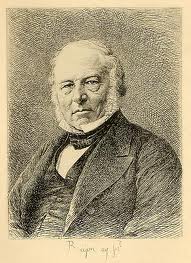
I bet you have never heard of Rowland Hill. Like so many important reformers, Mr. Hill has faded into partial obscurity and only those interested in 19th century English history will have run into his name. But it is a prestigious name and one worth knowing. Hill was a teacher, inventor, and social reformer who was born in 1795 and died in 1879. Hill's father, Thomas Wright Hill, was an educator from Worcestershire and was a personal friend of Joseph Priestly, Thomas Paine, and Richard Price. As an educator Rowland Hill set up his own school in Birmingham which gained international fame. Hill was one of the first major educators to insist that encouragement and gentleness in education was not only more humane but also would, in the long run, be more efficacious.
Hill was obsessed by the shortcomings in the English postal system and he spent years attempting to create a model for reform of the system. Hill understood two central shortcomings of the post. Most importantly, he thought that it was far too expensive and inefficient both for the personal interests of British People and for the interests of the British economy. Before Hill's reforms many of the letters that were sent in England went by so-called 'franks' which was essentially a system of free postage used by MPs, Lords, and other government officials. Letters were so expensive to send that fraud was widespread and people would even resort to sending c.o.d. letters to loved ones with nothing in them, after which the loved one would refuse delivery, in a kind of system of secret message letting people know all was well. Hill understood that the difficulty that people experienced in contacting family members was not only a major emotional hardship but it made them reluctant to travel, lest they lose contact with loved ones. Hill also understood that not only were the franks costing the government money and resources, but exorbitant postal costs were standing in the way of business.
As they always are, the Tories were reactionary and shortsighted and under Prime Ministers Peel and Wellington, Hill's plans were resisted and attacked. But with the help of Melbourne (and eventually Lord John Russell) Hill's plans for an inexpensive, nationally organized postal system with one penny stamps was adopted. Russell made Hill the Secretary of the Post Office and he was knighted in turn. Perhaps most significantly, Hill is usually credited with the invention of the postage stamp. Though it took many years after Hill's plans were enacted for the Post Office to begin to make as much revenue as they had before, Hill's plans modernized the Postal System and not only helped individuals but actually helped modernize the British economy.
Like most reformers, Hill was attacked at every turn by myopic conservatives who cared nothing for people or for more generalized prosperity, but only cared for their own power and privilege. But Hill would not be turned aside and his determination should be celebrated and admired. Twenty years from now when our education system is defunct, our economy is entirely owned by foreign corporations, there are few or no family farms left, there is no public pensions system, remember the determination of Rowland Hill. We are going to need a dose of it ourselves.
Saturday, October 22, 2011
Friday, October 21, 2011
Chinese Toddlers and Keeping Hope Alive. . .
All my life people close to me have tried to buoy my spirits and convince me that human society isn't really that bad. And I have always tried, to borrow a phrase from Mr. Jackson, to keep hope alive. After all, I recognize that I have been very lucky in life; I have been able to devote my life to art and writing, I have had people in my life that I loved and that have loved me back. And I have always maintained a firm belief in socialist politics because I think that society should exist for the benefit of all and that the only hope for our race is that we take care of each other.
All that said, it is sometimes difficult to "keep hope alive," don't you think? Everyone knows the story now of the little girl in China who was run over by a car in a market and had to just lay there on the street while no one came to her aid. Another truck event ran over her again as she lay there, it slowed down as though it was going over a speed bump. I have seen the event on video and it is unbelievable, startling, and ultimately profoundly saddening. How does one come to grips with such an event? It happened thousands of miles away to a little girl that I don't know and will never know. However, somehow watching those people who casually walked around and stepped over a small, dying, little toddler has made it just a little more difficult for me to maintain the faith that we all require to go on.
(An important post-script to the story of the little dying toddler; after 19 people went by without even bothering to stop and help the dying girl, the person who did finally stop was a very poor old woman who ekes out a meager living collect junk form the city's trash. Why does it not surprise me that it was the poorest of the poor who stooped to help a child?)
All that said, it is sometimes difficult to "keep hope alive," don't you think? Everyone knows the story now of the little girl in China who was run over by a car in a market and had to just lay there on the street while no one came to her aid. Another truck event ran over her again as she lay there, it slowed down as though it was going over a speed bump. I have seen the event on video and it is unbelievable, startling, and ultimately profoundly saddening. How does one come to grips with such an event? It happened thousands of miles away to a little girl that I don't know and will never know. However, somehow watching those people who casually walked around and stepped over a small, dying, little toddler has made it just a little more difficult for me to maintain the faith that we all require to go on.
(An important post-script to the story of the little dying toddler; after 19 people went by without even bothering to stop and help the dying girl, the person who did finally stop was a very poor old woman who ekes out a meager living collect junk form the city's trash. Why does it not surprise me that it was the poorest of the poor who stooped to help a child?)
Tuesday, October 18, 2011
How you gonna keep 'em down on the farm?
We know for certain that the Conservative crime bill will not reduce crime. We know for certain that it will cost billions of dollars. In every culturally similar context, efforts to reduce crime by putting more people in prison, even where that system of incarceration attempts to include rehabilitation programs, does nothing to reduce crime (in many cases it increases crime) and raises costs by so much that eventually it threatens the jurisdiction with bankruptcy. Prisons are a way for the state to spend billions in the creation of a criminal training programe.
And the evidence against Harper and his fascist cohorts is mounting everyday, and now even Texas has lined up against our Government's program. So we have to ask ourselves, 'why does this government want to spend billions of dollars on something that they know won't reduce crime, may actually increase criminal activity, and will eventually threaten the country with bankruptcy?' I believe that the answer is fairly clear; the Conservatives want to bankrupt the state, pure and simple. And the reason that they seek to bankrupt the nation is that it will eventually destroy social programs, the thing that Conservatives despise the most. For many years crime rates were going down, literacy rates were falling, social programs were keeping people from starvation and total desperation. But Conservatives hate government sponsored social programs so much that they would do anything to destroy them, even send the country into bankruptcy. The only kind of government program the conservatives want to maintain are those that take money from the people and put it in the hands of corporations and the rich.
Of course, all of this begs another question; why do conservative leaders want people to be poor and uneducated? Well, for the same reason that the rich and powerful have always wanted the people to be poor and uneducated - because they are easier to control. When great English reformers, such as Samuel Whitbread and Lord Erskine, actively advocated for nationally sponsored, primary education, Tories argued against them in the House of Commons by essentially maintaining that if you gave the working-class education they would only become dissatisfied with their place in society and would demand more from life. Most conservatives essentially believe that they will be part of the wealthy elite and the last thing they want is a society in which everyone has an education and a basic level of income because they want to be able to use their wealth to wield power over others, it is their way of feeling better about themselves and convincing themselves that their power is a result of their merit. This problem goes back centuries. The Catholic Church and the leaders of European feudalism actively kept people ignorant and hungry because they knew that such people were easier to control. In many countries during the age of the slave-trade, it was illegal to teach slaves to read because even slave-owners knew that knowledge is power.
The equation is simple; spend bilions on useless aspects of the police state, gradually bankrupt the state and have a ready made excuse to take money out of health, education, and other social programs, end up with an ignorant, hungry, desperate population that will do what they are told.
So next time you scratch your head in exasperation at the apparent stupidity of the Conservative effort to spend billions building more prisons, just remember it is not that they don't understand the facts, it is because they want an ignorant, desperate, hungry, population that understands that they should obey their economic masters. That is what it is all about.
And the evidence against Harper and his fascist cohorts is mounting everyday, and now even Texas has lined up against our Government's program. So we have to ask ourselves, 'why does this government want to spend billions of dollars on something that they know won't reduce crime, may actually increase criminal activity, and will eventually threaten the country with bankruptcy?' I believe that the answer is fairly clear; the Conservatives want to bankrupt the state, pure and simple. And the reason that they seek to bankrupt the nation is that it will eventually destroy social programs, the thing that Conservatives despise the most. For many years crime rates were going down, literacy rates were falling, social programs were keeping people from starvation and total desperation. But Conservatives hate government sponsored social programs so much that they would do anything to destroy them, even send the country into bankruptcy. The only kind of government program the conservatives want to maintain are those that take money from the people and put it in the hands of corporations and the rich.
Of course, all of this begs another question; why do conservative leaders want people to be poor and uneducated? Well, for the same reason that the rich and powerful have always wanted the people to be poor and uneducated - because they are easier to control. When great English reformers, such as Samuel Whitbread and Lord Erskine, actively advocated for nationally sponsored, primary education, Tories argued against them in the House of Commons by essentially maintaining that if you gave the working-class education they would only become dissatisfied with their place in society and would demand more from life. Most conservatives essentially believe that they will be part of the wealthy elite and the last thing they want is a society in which everyone has an education and a basic level of income because they want to be able to use their wealth to wield power over others, it is their way of feeling better about themselves and convincing themselves that their power is a result of their merit. This problem goes back centuries. The Catholic Church and the leaders of European feudalism actively kept people ignorant and hungry because they knew that such people were easier to control. In many countries during the age of the slave-trade, it was illegal to teach slaves to read because even slave-owners knew that knowledge is power.
The equation is simple; spend bilions on useless aspects of the police state, gradually bankrupt the state and have a ready made excuse to take money out of health, education, and other social programs, end up with an ignorant, hungry, desperate population that will do what they are told.
So next time you scratch your head in exasperation at the apparent stupidity of the Conservative effort to spend billions building more prisons, just remember it is not that they don't understand the facts, it is because they want an ignorant, desperate, hungry, population that understands that they should obey their economic masters. That is what it is all about.
Monday, October 17, 2011
Our Casino Economy. . .
Today, in response to a question, the interim leader of the NDP vaguely floated the idea of capping the salaries of CEOs in private corporations. Needless to say, rightwingers jumped on the idea and branded it some kind of crazy communist notion. It is, of course, not a particularly radical idea. In theory, we cap the minimum salary in our society to ensure that no one is too poor; it is not a wild idea that we could cap the upper end of salaries to ensure that no one is too rich. Now even though I don't agree with the rightwingers that this idea is radically leftwing, I agree that it is not a particularly substantive idea. Such a move would do little or nothing to actually address the real problems of poverty and inequality in society and would largely be a purely optical policy.
But the rightwing has bigger problems when we, as a society, begin to talk about issues of poverty, inequality, and a democratic deficit. The problems are that a) the rightwing, generally speaking, doesn't actually want to address these issues. Rightwingers are generally ignorant enough to believe that the inequalities in society are a result of a meritocracy and that these inequalities reflect what is basically a real inequality between people's value and abilities. Thus attempting to address these inequalities is perceive, by many on the right, to be morally objectionable. People's wealth, they figure, reflects their ability and therefore, that is the way it should be. b)the continuation of policies that ensure corporate wealth and maintain a system whereby the wealthy are the only ones that can get decent educations continues a system of inequality that the right basically believe should exist. c) The rightwing is entirely aware that any real moves toward genuine democracy would undermine the social and economic relations that they hope to maintain. and, perhaps most importantly, d) any solution that we offer in public discourse, no matter how modest, that attempts to deal with a society of radical inequality will be condemned by the right as a wacko, leftwing, nutbar idea.
The fact is that capping CEO salaries will do little to address our social problems. We live in a society where large corporations earn billions in profit while paying little or no tax. This is true of the US, Canada, and most of the Western world. And while they earn billions and billions in profit, more and more people are falling into poverty, unemployment, underemployment, and complete desperation. The only way to address this issue is to force corporations wherever they operate to pay proper taxes and reinvest in communities. Furthermore, we need to begin to put an end to currency speculation and market futures. We need to tax all financial transactions (the so-called Tobin Tax) and bring the casino economy to an end. Then we need to invest properly in education so that everyone has a good chance to enrich their life and create a guaranteed income program. Though this list is not exhaustive, it is only through such efforts that the inequality that has inspired the Occupy Wall Street movement will begin to be solved. But for all the rightwing condemnation of the NDP and its radical solutions, none of these things are even on the table. But just as the ignorance and arrogance of the French Aristocracy led to the Revolution in 1789, so the ignorance and arrogance of today's capitalist elite will lead to conflagration.
The reality is that our society has become like a person addicted to gambling with all the same negative effects on a grand scale. Its time to put a stop to the massive system of legalized gambling and create a society which serves all of our needs. Pure and Simple.
But the rightwing has bigger problems when we, as a society, begin to talk about issues of poverty, inequality, and a democratic deficit. The problems are that a) the rightwing, generally speaking, doesn't actually want to address these issues. Rightwingers are generally ignorant enough to believe that the inequalities in society are a result of a meritocracy and that these inequalities reflect what is basically a real inequality between people's value and abilities. Thus attempting to address these inequalities is perceive, by many on the right, to be morally objectionable. People's wealth, they figure, reflects their ability and therefore, that is the way it should be. b)the continuation of policies that ensure corporate wealth and maintain a system whereby the wealthy are the only ones that can get decent educations continues a system of inequality that the right basically believe should exist. c) The rightwing is entirely aware that any real moves toward genuine democracy would undermine the social and economic relations that they hope to maintain. and, perhaps most importantly, d) any solution that we offer in public discourse, no matter how modest, that attempts to deal with a society of radical inequality will be condemned by the right as a wacko, leftwing, nutbar idea.
The fact is that capping CEO salaries will do little to address our social problems. We live in a society where large corporations earn billions in profit while paying little or no tax. This is true of the US, Canada, and most of the Western world. And while they earn billions and billions in profit, more and more people are falling into poverty, unemployment, underemployment, and complete desperation. The only way to address this issue is to force corporations wherever they operate to pay proper taxes and reinvest in communities. Furthermore, we need to begin to put an end to currency speculation and market futures. We need to tax all financial transactions (the so-called Tobin Tax) and bring the casino economy to an end. Then we need to invest properly in education so that everyone has a good chance to enrich their life and create a guaranteed income program. Though this list is not exhaustive, it is only through such efforts that the inequality that has inspired the Occupy Wall Street movement will begin to be solved. But for all the rightwing condemnation of the NDP and its radical solutions, none of these things are even on the table. But just as the ignorance and arrogance of the French Aristocracy led to the Revolution in 1789, so the ignorance and arrogance of today's capitalist elite will lead to conflagration.
The reality is that our society has become like a person addicted to gambling with all the same negative effects on a grand scale. Its time to put a stop to the massive system of legalized gambling and create a society which serves all of our needs. Pure and Simple.
Feeling that Absence. . . . .
Though it seems as though my father died only yesterday, it has been over a year now. I guess it has taken me a while to really understand why his death has been so devastating for me. I understand the grieving process as explained by so-called experts, though I must admit that I am not particularly impressed with the idea of reducing human emotions to an external forumla. But regardless of the expectations of the 'normal' grieving process, the death of my father goes far beyond a simple process of grief. It has taken a bite out of me and I know I will never 'recover' from it.
My father and I were closer than any father and son I have ever met. Part of this was simply because my parents were divorced when I was seven and I lived with my father in a separate country from my mother and my sister. We became even closer when I started very young to pursue a career in art and I eventually attended the Alberta College of Art where my dad taught for twenty years. After I graduated from Art College, my father and I regularly worked together in a professional capacity as well as constantly supporting each other in the personal development of our art work. For most of my years as an adult I lived with my father, even when I was married and had a child.
All of these elements of our relationship suggest an unusual closeness. However, it was a different aspect of our relationship that made my father and I exceptionally close, and that is that we were misfits in the world together. I have been a misfit since I was a child. I have never fit in anywhere that I have been. I began to have what might be considered "mental problems" from a young age and I was never able to 'fit in' anywhere. I have had friends but very few close ones. Art and Literature were fitting pursuits for me because one can disappear into a separate reality and society's expectations of you are very different from people in the 'normal' working world. My political, ideological, and aesthetic beliefs are so alien from the vast majority of people that I feel out of place with my own species. But all my life, my father and I could relate to each other. He was, in his own way, a real misfit. He grew up in a very working-class environment, but was determined to live a very different life from his father. He dropped out of school when he was 14 and did dozens of different jobs, eventually ending up in art college. Even as an artist, my dad did many different jobs and the only place he came close to 'fitting in' was as a teacher. But together, my father and I understood each other's alienation from society and our friendship was one of the only places that I felt as though, even though I am a misfit, I was somewhat at ease. Even when he was very sick, my dad and I could laugh together and sometimes it felt as though it was worth living just for those moments in which I didn't feel so separated from the world.
I am sure that it sounds like self-pity, and perhaps there is a significant element of that in my recent experiences. But without my dad I feel a whole lot more separated from the world in which I live. He is sorely missed.
My father and I were closer than any father and son I have ever met. Part of this was simply because my parents were divorced when I was seven and I lived with my father in a separate country from my mother and my sister. We became even closer when I started very young to pursue a career in art and I eventually attended the Alberta College of Art where my dad taught for twenty years. After I graduated from Art College, my father and I regularly worked together in a professional capacity as well as constantly supporting each other in the personal development of our art work. For most of my years as an adult I lived with my father, even when I was married and had a child.
All of these elements of our relationship suggest an unusual closeness. However, it was a different aspect of our relationship that made my father and I exceptionally close, and that is that we were misfits in the world together. I have been a misfit since I was a child. I have never fit in anywhere that I have been. I began to have what might be considered "mental problems" from a young age and I was never able to 'fit in' anywhere. I have had friends but very few close ones. Art and Literature were fitting pursuits for me because one can disappear into a separate reality and society's expectations of you are very different from people in the 'normal' working world. My political, ideological, and aesthetic beliefs are so alien from the vast majority of people that I feel out of place with my own species. But all my life, my father and I could relate to each other. He was, in his own way, a real misfit. He grew up in a very working-class environment, but was determined to live a very different life from his father. He dropped out of school when he was 14 and did dozens of different jobs, eventually ending up in art college. Even as an artist, my dad did many different jobs and the only place he came close to 'fitting in' was as a teacher. But together, my father and I understood each other's alienation from society and our friendship was one of the only places that I felt as though, even though I am a misfit, I was somewhat at ease. Even when he was very sick, my dad and I could laugh together and sometimes it felt as though it was worth living just for those moments in which I didn't feel so separated from the world.
I am sure that it sounds like self-pity, and perhaps there is a significant element of that in my recent experiences. But without my dad I feel a whole lot more separated from the world in which I live. He is sorely missed.
Sunday, October 16, 2011
Just a Thought. . . .
A Sunday morning thought from my favorite writer.
"It is indeed time that a stand was made against the pedantic and prosaic tyranny of orthography."
-E.V. Lucas
"It is indeed time that a stand was made against the pedantic and prosaic tyranny of orthography."
-E.V. Lucas
Saturday, October 15, 2011
For the Benefit of All . . . . .
I have spent years studying the complex, so-called neo-modern, continental philosophies which, in recent years, have blown away a great deal of traditional rational, teleological, analytical, meta-theoretical ideas. And I have a great deal of respect for many remarkable neo-modern thinkers like Roland Barthes, Jacques Derrida, and Gayatri Spivak.
And yet, at another level, I think the questions of practical political philosophy is much simpler than many make it out to be. I think that there is one basic reason for society and that is mutual benefit. If society is not a structure that is intended to create mutual benefit, then I really see little justification for it. This, in simplest terms, is why I am, and have always been, a socialist. My grandfather was a founding member of the English Communist Party and spent 20 years as a shop stewart for the local of his engineer's union in London. He and his associates fought hard to ensure the rights that we all take for granted today. He worked as an activist because he believed that society should exist to ensure that everyone has a fair share in its benefits, not only a select few. Rightwingers and capitalist have told me since I was a child that the only reasonable motive for human ambition is personal financial gain. But the example that my grandfather set taught me that this simply wasn't true and all my life I have observed that the lion's share of people work continuously and tirelessly for the benefit of others.
Some people talk about the "occupy Wall Street" crowd as being a bunch of nut-bars with no direction and no purpose. But they possess the simplest of all purposes, to wit: a society that exists for the benefit of everyone, in which we are all stakeholders in a common future, in which the weak and vulnerable are given a voice, in which poetry matters as much as interest rates, in which we all belong and none are excluded, and in which people are judged by the content of their character rather than their gender, their color, or their sexual preference.
"Let us live for the beauty of our own reality."
-Charles Lamb
And yet, at another level, I think the questions of practical political philosophy is much simpler than many make it out to be. I think that there is one basic reason for society and that is mutual benefit. If society is not a structure that is intended to create mutual benefit, then I really see little justification for it. This, in simplest terms, is why I am, and have always been, a socialist. My grandfather was a founding member of the English Communist Party and spent 20 years as a shop stewart for the local of his engineer's union in London. He and his associates fought hard to ensure the rights that we all take for granted today. He worked as an activist because he believed that society should exist to ensure that everyone has a fair share in its benefits, not only a select few. Rightwingers and capitalist have told me since I was a child that the only reasonable motive for human ambition is personal financial gain. But the example that my grandfather set taught me that this simply wasn't true and all my life I have observed that the lion's share of people work continuously and tirelessly for the benefit of others.
Some people talk about the "occupy Wall Street" crowd as being a bunch of nut-bars with no direction and no purpose. But they possess the simplest of all purposes, to wit: a society that exists for the benefit of everyone, in which we are all stakeholders in a common future, in which the weak and vulnerable are given a voice, in which poetry matters as much as interest rates, in which we all belong and none are excluded, and in which people are judged by the content of their character rather than their gender, their color, or their sexual preference.
"Let us live for the beauty of our own reality."
-Charles Lamb
Subscribe to:
Posts (Atom)


